A Swiss detour, Scientific American, and a child's drawing
This game is older than video games. Its exact origins are unknown, but it was already being played in Europe in the 1960s under names like Vector Rally, Vector Formula or Graph Racers.
It reached the wider world in January 1973, when Martin Gardner devoted his Mathematical Games column in Scientific American to it. Gardner had learned it from Jürg Nievergelt — a computer scientist born in Lucerne, then teaching at the University of Illinois, who had just picked the game up on a trip back to Switzerland. Nievergelt had been Swiss junior chess champion in 1957 and had written his ETH Zurich degree thesis on game theory; he would later return home to co-found the computer science department at ETH Zurich.
“A truly remarkable simulation of automobile racing.” Martin Gardner, Scientific American, January 1973 — who noted the game was “virtually unknown” in the United States
That summer Car and Driver picked it up too, calling its resemblance to real racing “almost supernatural”: enter a turn too fast and you spin; brake too early and you lose time getting back on the power.
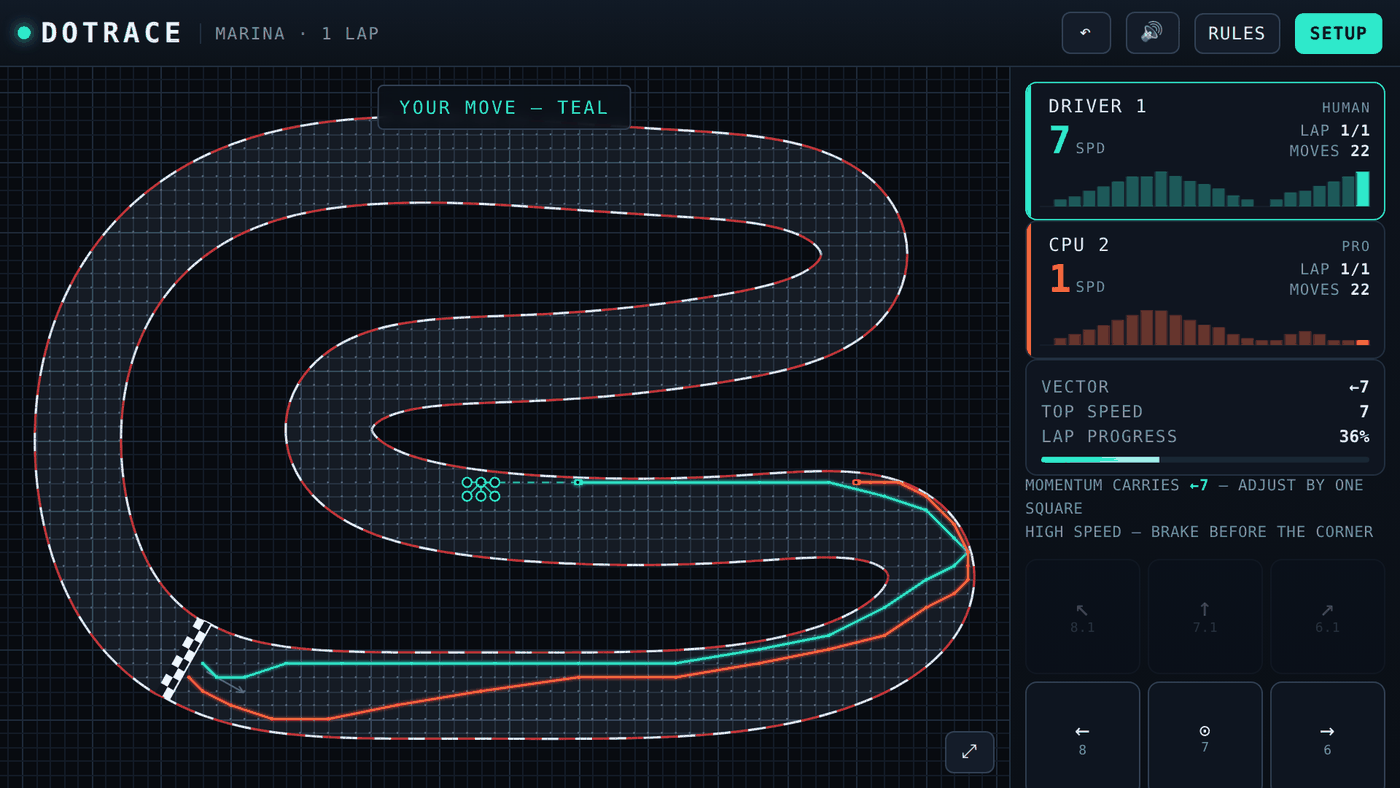
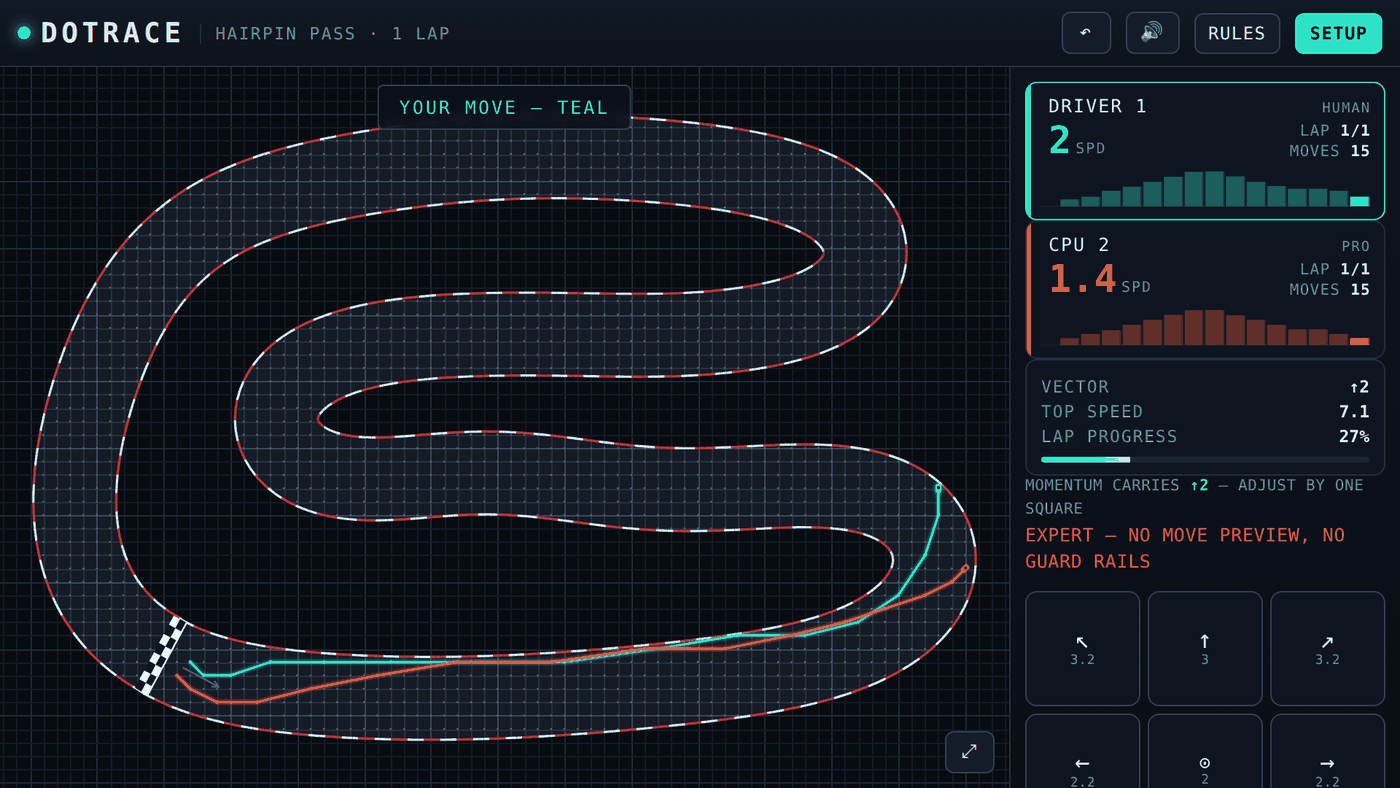
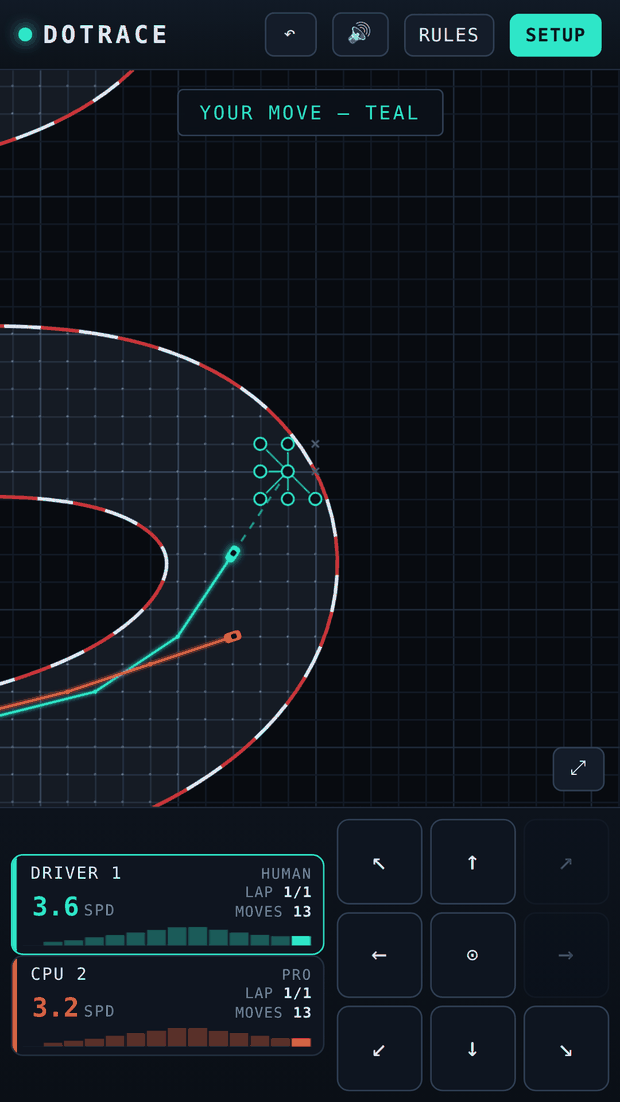
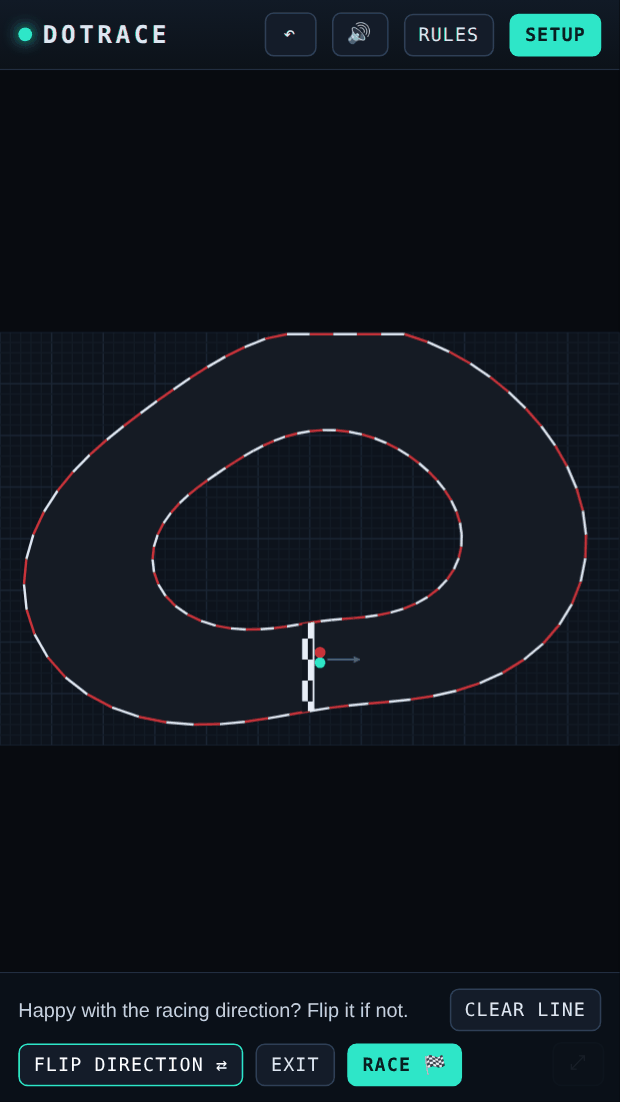
Fifty years later, a child drew the same game on a sheet of squared paper — two cars, an outer line, an inner line, a start line and eight little arrows around each dot — and explained the rules to his father. DotRace is that drawing, with the dashboard it always deserved.
The game circulates in Europe on squared paper, under half a dozen different names.
Martin Gardner publishes the rules in Scientific American (vol. 228, no. 1, pp. 108–115), crediting Jürg Nievergelt and his trip to Switzerland.
Car and Driver calls the resemblance to real racing “almost supernatural”.
Computer scientists prove that deciding who wins is computationally hard.
Maths and physics teachers use it around the world to teach vectors and kinematics.